Fraud Code
Fraud Code puts the MouseCat investigation engine on the command line. Fraud strategists answer in an afternoon the questions that used to mean a ticket to data engineering and a week of waiting.
What Companies Use It For.
Investigate a pattern the moment you notice it
Ask for every account that added a payee and moved money within the hour, across the last 90 days — then have MouseCat investigate the ones that look organized.
Test a change before you ship it
Backtest a proposed rule or agent change against your own labeled history and read precision and recall on your cases, not a vendor benchmark.
Build your own agents
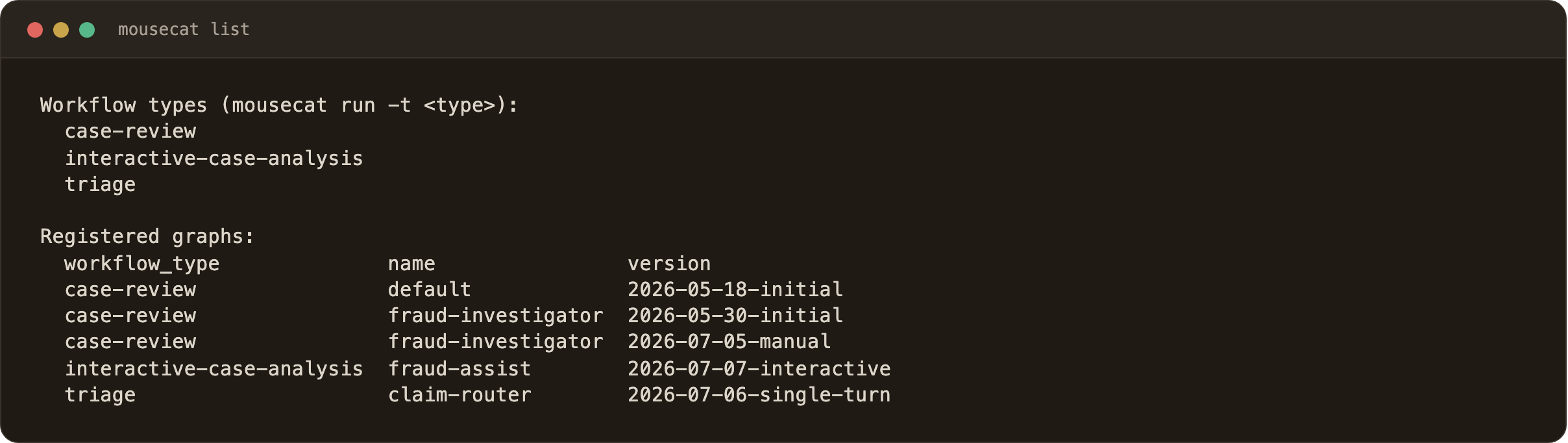
Your engineers register custom agents, evaluators, and commands on the same engine that runs in production. What your team builds in the CLI deploys as the same artifact.
![Terminal session: mousecat run of the fraud-investigator graph on case CS-2026-0388. The run is done with a verdict of review. The investigation tree shows five hypotheses worked in parallel — Investigator[not_fraud], [ato], [scam], [first_party] and [third_party], each taking about a minute — followed by a judge step, for a total of 3 minutes 27 seconds.](/cli/run.png)
How It Works.
Fraud Code is the production engine, not a separate tool: the same agents, tools, and data access, driven from your terminal. Work one case or batch thousands.
Pin the clock to a past date and the entire engine sees only the data that existed then, so a backtest cannot cheat. Results score against your ground truth — analyst annotations, chargebacks, dispute outcomes.
Strategists who prefer plain language can drive Fraud Code from an agentic assistant like Claude Code and let it use MouseCat as its investigative engine.
Get started.
We'll walk you through MouseCat live.